Five-day professional program. Approximately 25-30 training hours. Final agenda, language and delivery arrangements are confirmed in the proposal.
Course Overview
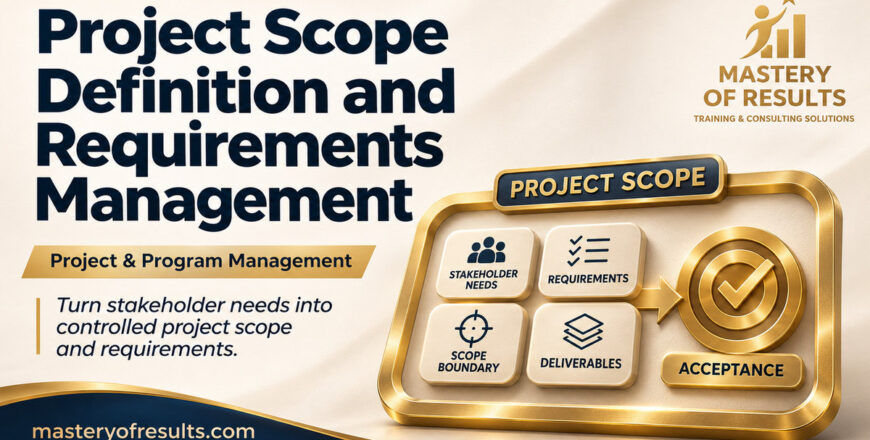
Turn stakeholder needs into controlled project scope and requirements.
This proposed five-day program develops a structured approach through case analysis, facilitated discussion and practical working documents. Participants adapt the learning to their organizational context and produce a final project scope and requirements baseline.
Learning Outcomes
Assess project purpose and requirements sources.
Evaluate requirements elicitation and clarification.
Apply a structured approach to scope boundaries and acceptance criteria.
Develop recommendations for traceability, changes and scope governance.
Prepare and present a project scope and requirements baseline.
Who Should Attend
Project managers, program coordinators, PMO professionals and project sponsors.
Relevant professional experience is recommended. Participant responsibilities and prerequisite knowledge are reviewed during scoping.
Training Methodology
Facilitated discussion, worked examples, anonymized case analysis, practical workshops, peer feedback and an applied final assignment.
Learning assessment may include a baseline discussion, review of working documents and a final presentation. Completion requirements are confirmed in the proposal.
Course Tools and Templates
Project purpose and requirements sources working brief – proposed exercise document.
Requirements elicitation and clarification working brief – proposed exercise document.
Scope boundaries and acceptance criteria working brief – proposed exercise document.
Traceability, changes and scope governance working brief – proposed exercise document.
Project scope and requirements baseline – proposed exercise document.
Delivery Requirements
Classroom, live online and in-house formats can be arranged by agreement. Venue, platform, language, timetable, trainer and materials are confirmed in writing.
A laptop may be needed for planning and analytical exercises. Required software, access and prerequisite skills are agreed before delivery.
Course Customization
The proposed five-day agenda can be adapted to the participant group, sector and organizational objectives. Dates, fees, delivery suitability and final activities are confirmed in the written proposal.
Course Outline
Proposed sequence, subject to the agreed training proposal.
Day 1 – Project purpose and requirements sources
Define the context, assess current practices and identify the key decisions relating to project purpose and requirements sources.
Practical output: Project purpose and requirements sources working brief
Day 2 – Requirements elicitation and clarification
Interpret sample information, compare suitable approaches and document assumptions for requirements elicitation and clarification.
Practical output: Requirements elicitation and clarification working brief
Day 3 – Scope boundaries and acceptance criteria
Apply structured tools to an anonymized case and develop recommendations for scope boundaries and acceptance criteria.
Practical output: Scope boundaries and acceptance criteria working brief
Day 4 – Traceability, changes and scope governance
Review responsibilities, risks and follow-up measures through a practical exercise on traceability, changes and scope governance.
Practical output: Traceability, changes and scope governance working brief
Day 5 – Integrated scope definition workshop
Integrate the course learning into a practical assignment on integrated scope definition workshop; present recommendations and an implementation roadmap.
Practical output: Project scope and requirements baseline