Five-day professional program. Approximately 25-30 training hours. Final agenda, language and delivery arrangements are confirmed in the proposal.
Course Overview
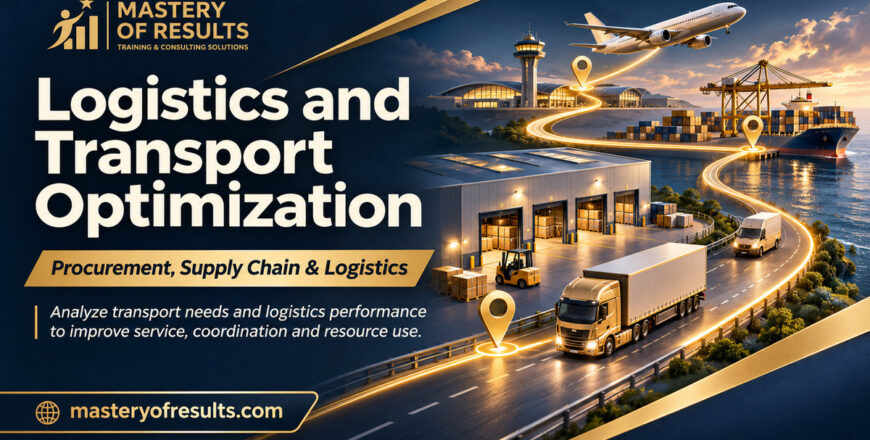
Analyze transport needs and logistics performance to improve service, coordination and resource use.
This five-day professional program combines focused discussion, practical workshops and a course-specific applied project. Participants work with sample information or anonymized organizational cases and develop outputs that can be adapted to their workplace.
Learning Outcomes
Develop and review a practical logistics flow map.
Develop and review a practical transport option comparison.
Develop and review a practical dispatch and coordination plan.
Develop and review a practical logistics performance review.
Develop and review a practical logistics optimization action plan.
Who Should Attend
Logistics managers, transport coordinators, distribution teams and operations planners.
Relevant professional experience is recommended. The final level and case complexity can be adapted to the participant group.
Training Methodology
Interactive discussions, worked examples, case analysis, practical workshops, role practice where relevant, peer feedback and a final applied presentation.
Assessment can include a short baseline review, evaluation of practical outputs and the final project. Attendance and completion requirements are agreed in the proposal.
Course Tools and Templates
Logistics flow map template or working document.
Transport option comparison template or working document.
Dispatch and coordination plan template or working document.
Logistics performance review template or working document.
Logistics optimization action plan template or working document.
Delivery Requirements
Classroom, live online and private organizational delivery are available by agreement. The final venue, platform, session timing, training language and required materials are confirmed during planning.
Participants should bring a laptop where the exercises involve models, dashboards or digital tools. Software selection, licensing and any prerequisite skills are agreed before delivery.
Course Customization
The proposed five-day sequence can be adapted to the organization, industry, participant experience and learning objectives. The final agenda and practical activities are confirmed in the written proposal.
Course Outline
Proposed sequence, subject to the agreed training proposal.
Day 1 – Logistics flows and customer requirements
Assess the context, review a representative scenario, and identify priorities related to logistics flows and customer requirements.
Practical output: Logistics flow map.
Day 2 – Transport options, routing and capacity
Compare approaches, interpret sample information, and develop a structured approach to transport options, routing and capacity.
Practical output: Transport option comparison.
Day 3 – Scheduling, dispatch and coordination
Apply the course tools to a realistic workplace scenario focused on scheduling, dispatch and coordination.
Practical output: Dispatch and coordination plan.
Day 4 – Costs, service measures and disruption response
Test a proposed approach, discuss exceptions and responsibilities, and refine costs, service measures and disruption response.
Practical output: Logistics performance review.
Day 5 – Logistics optimization case
Integrate the learning, present recommendations, and build an implementation plan for logistics optimization case.
Practical output: Logistics optimization action plan.