
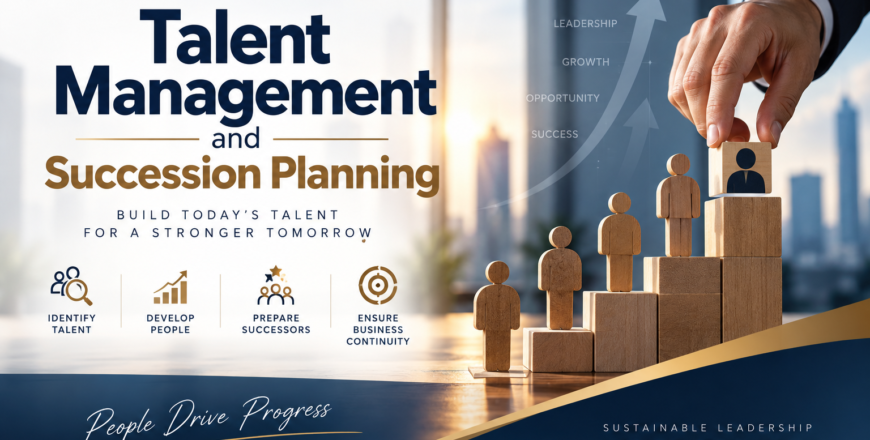
Talent Management and Succession Planning





- Description
- Curriculum
- Notice
Advanced 10-Day Professional Program
Duration: 10 Training Days
Daily Duration: Approximately 3–4 Hours
Total Training Hours: Approximately 50-60 Hours
Level: Advanced
Theory: 40%
Practical: 60%
Delivery: Classroom / Virtual / Blended
Language: English / Arabic
Course Overview
The Talent Management and Succession Planning program is designed to help HR professionals and organizational leaders develop a practical and structured approach to identifying, developing, and preparing talent for critical and future roles.
The program focuses on the essential areas organizations need to establish an effective talent and succession system, including identifying critical positions, distinguishing between performance and potential, identifying high-potential employees, conducting talent reviews, building succession plans, assessing successor readiness, and developing targeted development plans.
The course is delivered over 10 half-day training sessions, with approximately 40% theoretical learning and 60% practical application.
Theoretical Component – 40%
The theoretical component covers the essential frameworks and concepts required to understand and manage organizational talent effectively, including:
- Strategic Talent Management
- Critical Role Identification
- Performance vs. Potential
- High-Potential Employee Identification
- Talent Assessment
- 9-Box Grid
- Talent Review and Calibration
- Succession Planning
- Successor Readiness
- Succession Risk
- Talent Development
- Individual Development Planning
Practical Component – 60%
The practical component allows participants to apply these concepts through structured workshops, exercises, simulations, and case studies.
Participants will work on:
- Critical Role Mapping
- Talent Assessment Exercise
- Performance–Potential Analysis
- 9-Box Grid Workshop
- Talent Review Simulation
- Succession Planning Matrix
- Successor Readiness Assessment
- Individual Development Plan
- Final Talent & Succession Planning Project
By the end of the program, participants will have developed a practical Talent and Succession Planning Framework that can be adapted to their organization’s requirements.
10-Day Course Outline
Day 1 – Introduction to Strategic Talent Management
Theoretical
- What is Talent Management?
- Why Talent Management matters
- Linking talent priorities to organizational strategy
- Talent Management vs. traditional HR practices
Practical
Talent Management Diagnostic
Participants assess a sample organization’s current talent management practices and identify key gaps.
Output: Talent Management Gap Analysis
Day 2 – Identifying Critical Roles
Theoretical
- What makes a role critical?
- Strategic importance
- Skill scarcity
- Business dependency
- Replacement difficulty
- Knowledge concentration
Practical
Critical Role Mapping Workshop
Participants evaluate a sample organizational structure and identify priority roles.
Output: Critical Roles Matrix
Day 3 – Identifying Talent
Theoretical
- What defines talent?
- High Performer vs. High Potential
- Key Talent
- Emerging Talent
- Performance and potential criteria
Practical
Talent Identification Exercise
Participants assess employee profiles using defined criteria.
Output: Talent Assessment Sheet
Day 4 – Performance, Potential and the 9-Box Grid
Theoretical
- Understanding performance
- Understanding potential
- Potential indicators
- Introduction to the 9-Box Grid
- Limitations and appropriate use of the tool
Practical
9-Box Grid Workshop
Participants evaluate simulated employee profiles and position them within the matrix.
Output: 9-Box Talent Matrix
Day 5 – Talent Review and Calibration
Theoretical
- Purpose of Talent Reviews
- Calibration principles
- Evidence-based talent decisions
- Common assessment biases
- Roles of HR and managers
Practical
Talent Review Simulation
Participants conduct a simulated Talent Review meeting and resolve different managerial assessments.
Output: Calibrated Talent Review
Day 6 – Succession Planning Fundamentals
Theoretical
- What is Succession Planning?
- Replacement Planning vs. Succession Planning
- Identifying succession priorities
- Building successor pools
- Short-term and long-term succession
Practical
Succession Mapping Workshop
Participants identify possible successors for selected critical roles.
Output: Succession Planning Matrix
Day 7 – Successor Readiness and Succession Risk
Theoretical
- Assessing successor readiness
- Ready Now
- Ready in 1–2 Years
- Longer-term successors
- Succession risk
- Business continuity considerations
Practical
Successor Readiness Assessment
Participants evaluate potential successors and identify development gaps.
Output: Successor Readiness Map
Day 8 – Developing Talent
Theoretical
- Development strategies for high-potential employees
- Stretch Assignments
- Job Rotation
- Coaching
- Mentoring
- Cross-Functional Exposure
Practical
Talent Development Workshop
Participants select appropriate development interventions for different employee profiles.
Output: Talent Development Plan
Day 9 – Individual Development Planning
Theoretical
- Connecting development to future roles
- Competency gaps
- Career aspirations
- Development objectives
- Measuring development progress
Practical
Individual Development Plan Workshop
Participants prepare a structured development plan for a potential successor.
Output: 12-Month Individual Development Plan
Day 10 – Integrated Talent & Succession Planning
Theoretical
- Integrating Talent Management and Succession Planning
- Roles and responsibilities
- Review cycles
- Basic talent indicators
- Implementation considerations
Practical
Final Applied Project
Participants develop an integrated Talent and Succession Planning Framework for a simulated organization or, where appropriate, their own organization.
The project includes:
- Critical Roles
- Talent Identification Criteria
- Talent Matrix
- Successor Pool
- Successor Readiness
- Development Priorities
- Implementation Actions
Final Output: Talent & Succession Planning Framework
Who Should Attend?
The program is suitable for:
- HR Directors
- HR Managers
- Talent Management Managers
- Talent Development Specialists
- Organizational Development Professionals
- HR Business Partners
- Learning & Development Managers
- Workforce Planning Professionals
- Department Heads
- Senior Managers involved in Talent Reviews or Succession Planning
Course Level
Advanced
Previous experience in Human Resources, people management, organizational development, or management is recommended.
Key Learning Outcomes
By the end of the program, participants will be able to:
- Identify critical organizational roles.
- Differentiate between performance and potential.
- Establish practical talent identification criteria.
- Apply the 9-Box Grid appropriately.
- Participate effectively in Talent Review discussions.
- Identify potential successors for critical positions.
- Assess successor readiness.
- Identify key succession risks.
- Develop practical development plans for key talent.
- Build a structured Talent and Succession Planning Framework.
Flexible & Customizable Training
The recommended format for this program is 10 half-day training sessions of approximately 3–4 hours per day.
The program duration, content, practical activities, case studies, participant level, training schedule, and learning outcomes can be customized according to the organization’s needs, industry, internal HR systems, competency framework, and strategic priorities.
The program may also be redesigned as a 5-day intensive course or an extended professional development program where required.
Course Note
This program is designed as a 10-day half-day course, with approximately 3–4 training hours per day.
The course combines 40% theoretical learning and 60% practical application, including workshops, case studies, talent assessment exercises, succession mapping, and development planning.
The program is fully customizable. Duration, content, practical activities, case studies, participant level, and delivery format can be adjusted to meet the organization’s specific needs, industry requirements, and internal HR practices.
The course can be delivered in-house, classroom-based, virtually, or through blended learning.