
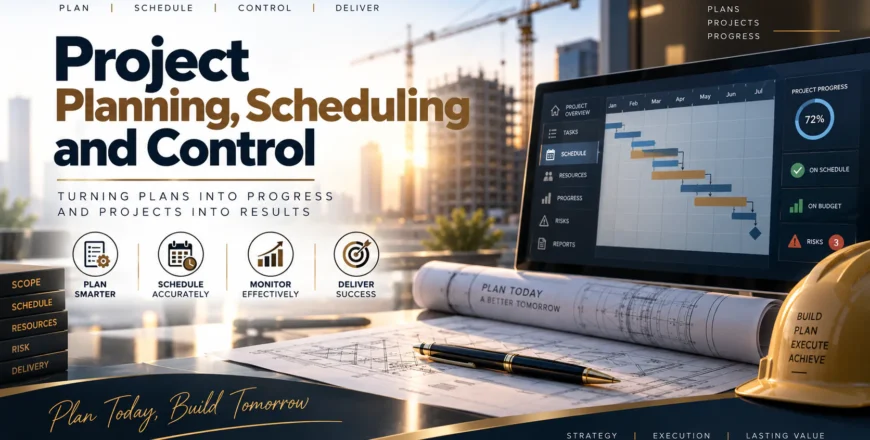
Project Planning, Scheduling and Control
• Recommended duration: 1 month, distributed over 4 weeks.
• Suggested training time: 48–72 hours, depending on the organization.
• The programme includes training sessions, workshops, applied assignments, and a final project; it does not mean daily training for 30 days.
• Weekly model: foundations; tools and applied methods; cases and simulation; applied project and evaluation.
• The final schedule is agreed with the organization before delivery.





- Description
- Curriculum
- Notice
One-Month Applied Professional Program
Duration: 1 Month
Recommended Training Hours: Approximately 90–120Hours
Level: Intermediate to Advanced
Theory: 40%
Practical: 60%
Delivery: Classroom / Virtual / Blended
Language: English / Arabic
Course Overview
The Project Planning, Scheduling and Control program is designed to help project professionals develop realistic project plans, build structured schedules, monitor progress, identify deviations, and take timely corrective action throughout the project lifecycle.
Effective project control requires more than creating a schedule at the beginning of a project. Project teams must define scope clearly, break work into manageable activities, establish logical relationships, estimate durations, identify critical activities, allocate resources, establish baselines, update progress, analyze variances, and communicate reliable information to management and stakeholders.
The program combines approximately 40% theoretical learning and 60% practical application, allowing participants to understand the principles of planning and project control while applying them through structured exercises, schedule-building workshops, project scenarios, progress updates, and control reports.
By the end of the program, participants will develop a practical Project Planning, Scheduling and Control Package that can be adapted to real projects.
Theoretical Component – 40%
Participants learn the essential concepts and methods related to:
- Project Planning Fundamentals
- Scope Definition
- Work Breakdown Structure
- Work Packages
- Activity Definition
- Activity Sequencing
- Schedule Logic
- Dependencies and Relationships
- Duration Estimation
- Project Milestones
- Network Diagrams
- Critical Path Method
- Float and Schedule Flexibility
- Resource Planning
- Resource Allocation
- Resource Constraints
- Schedule Baseline
- Progress Measurement
- Schedule Updating
- Planned vs. Actual Performance
- Schedule Variance
- Forecasting
- Corrective Actions
- Change Control
- Project Reporting
- Schedule Governance
Practical Component – 60%
Participants apply the concepts through:
- Project Scope Breakdown Exercise
- Work Breakdown Structure Workshop
- Activity Definition Exercise
- Logic and Dependency Mapping
- Network Diagram Development
- Critical Path Analysis
- Duration Estimation Exercise
- Milestone Planning
- Resource Allocation Workshop
- Baseline Schedule Development
- Progress Update Exercise
- Schedule Variance Analysis
- Delay Scenario Exercise
- Recovery Planning
- Project Control Dashboard Development
- Final Planning and Scheduling Project
By the end of the program, participants will develop a practical:
WBS, Project Schedule, Baseline, Progress Update, Variance Analysis, and Recovery Action Plan.
Who Should Attend?
The program is suitable for:
- Project Managers
- Assistant Project Managers
- Planning Engineers
- Scheduling Engineers
- Project Control Engineers
- Project Control Professionals
- Project Engineers
- Project Coordinators
- PMO Professionals
- Cost Engineers
- Construction Professionals
- Engineering Professionals
- Contract Professionals involved in project delivery
- Operations Professionals involved in projects
- Consultants
- Client Representatives
- Contractor Representatives
- Professionals responsible for project planning, monitoring, or reporting
Who May Not Need This Program?
The course may be less suitable for:
- Participants with no exposure to project-based work.
- Professionals seeking only basic project management awareness.
- Participants looking exclusively for advanced software-specific scheduling training.
- Professionals seeking specialist forensic delay analysis.
- Participants requiring an advanced cost control or Earned Value Management program only.
A foundation-level version can be developed for participants who are new to project planning.
Course Level
Intermediate to Advanced
Previous exposure to projects is recommended.
Participants do not need to be specialist planning engineers, but they should ideally understand basic concepts such as:
- Project Scope
- Deliverables
- Activities
- Milestones
- Resources
- Project Deadlines
- Project Responsibilities
Course Objectives
By the end of the program, participants should be able to:
- Understand the role of planning and scheduling throughout the project lifecycle.
- Translate project scope into a structured Work Breakdown Structure.
- Define project activities and milestones.
- Establish logical relationships between activities.
- Estimate activity durations realistically.
- Develop project network diagrams.
- Identify the Critical Path.
- Analyze schedule float.
- Establish a practical project baseline.
- Plan and allocate project resources.
- Measure and update project progress.
- Analyze schedule variances.
- Identify potential delays and schedule risks.
- Develop corrective and recovery actions.
- Prepare clear project control reports for management.
Learning Outcomes
Participants will be able to:
- Break project scope into manageable work packages.
- Develop a practical WBS.
- Define project activities.
- Sequence activities logically.
- Identify dependencies.
- Develop project milestones.
- Estimate activity durations.
- Build a project network.
- Calculate the Critical Path.
- Analyze total and available float.
- Establish a baseline schedule.
- Allocate resources to activities.
- Update actual project progress.
- Compare planned and actual performance.
- Identify schedule deviations.
- Forecast potential completion impacts.
- Develop recovery actions.
- Prepare project schedule reports.
Key Competencies Developed
- Project Planning
- Project Scheduling
- Work Breakdown Structure Development
- Activity Sequencing
- Critical Path Analysis
- Resource Planning
- Baseline Management
- Progress Monitoring
- Schedule Variance Analysis
- Forecasting
- Corrective Action Planning
- Project Controls
- Project Reporting
- Analytical Thinking
- Decision-Making
Participant Task
Participants work on a simulated project and are required to:
- Review the project scope.
- Develop the Work Breakdown Structure.
- Define project work packages.
- Identify activities and milestones.
- Establish activity relationships.
- Estimate activity durations.
- Develop the project network.
- Identify the Critical Path.
- Establish the project baseline.
- Allocate project resources.
- Update project progress.
- Analyze schedule variances.
- Identify delays and their potential impact.
- Develop corrective and recovery actions.
- Prepare a management project control summary.
Final Output
Project Planning and Control Package
including:
- Work Breakdown Structure
- Activity List
- Network Logic
- Baseline Schedule
- Progress Update
- Variance Analysis
- Recovery Plan
- Management Summary
Case Study Evaluation Criteria
| Criterion | Weight |
|---|---|
| Scope & WBS Quality | 15% |
| Schedule Logic | 20% |
| Critical Path Analysis | 20% |
| Progress & Variance Analysis | 20% |
| Recovery Planning | 15% |
| Practical Reporting | 10% |
Course Tools and Templates
Participants may receive:
- Project Planning Checklist
- Scope Breakdown Template
- Work Breakdown Structure Template
- WBS Dictionary Template
- Activity List Template
- Milestone Register
- Activity Dependency Worksheet
- Network Diagram Template
- Duration Estimation Sheet
- Critical Path Analysis Worksheet
- Resource Planning Template
- Baseline Schedule Template
- Progress Update Sheet
- Schedule Variance Analysis Template
- Delay Tracking Register
- Schedule Recovery Plan
- Project Control Dashboard
- Progress Report Template
- Look-Ahead Planning Template
- Project Status Summary
- 30-Day Planning Improvement Action Plan
Training Methodology
The program uses:
- Interactive Presentations
- Practical Planning Workshops
- Schedule-Building Exercises
- Case Studies
- Network Diagram Exercises
- Critical Path Analysis
- Resource Planning Workshops
- Progress Update Exercises
- Variance Analysis
- Delay Scenarios
- Group Analysis
- Problem-Based Learning
- Peer Review
- Final Applied Project
Approximately 60% of the program is dedicated to practical project planning, schedule development, progress analysis, and project control exercises.
Participant Assessment
Suggested assessment structure:
| Assessment | Weight |
|---|---|
| Pre- and Post-Assessment | 10% |
| WBS & Planning Workshops | 20% |
| Scheduling & Critical Path Exercise | 20% |
| Progress & Variance Analysis | 20% |
| Final Applied Project | 30% |
Suggested Completion Requirement
Approximately 70% overall, together with applicable attendance requirements.
The final assessment method can be customized according to the organization’s training policies and participant level.
Training Impact Measurement
After 30 Days
Possible indicators include:
- Increased use of structured WBS templates.
- Improved schedule logic.
- Clearer project milestones.
- Improved activity definition.
- Better planning documentation.
- Increased use of approved project baselines.
After 60 Days
Possible indicators include:
- More consistent project progress updates.
- Improved schedule variance reporting.
- Better identification of delayed activities.
- Improved use of look-ahead schedules.
- Increased clarity of project completion forecasts.
- Better resource planning practices.
After 90 Days
Possible indicators include:
- Improved schedule reporting consistency.
- Reduction in uncontrolled schedule deviations.
- Earlier identification of potential project delays.
- Improved use of recovery plans.
- Better management visibility of project performance.
- Improved integration between planning, project management, and project controls.
Final indicators should be selected according to the organization’s projects and available performance data.
Delivery Requirements
Classroom Delivery
Recommended facilities include:
- Professional Training Room
- Projector or Large Screen
- Flipcharts
- Whiteboards
- Breakout Tables
- Participant Laptops
- Spreadsheet Software
- Project Planning Templates
- Sample Project Data
- Digital or Printed Scheduling Exercises
Where software-based scheduling is required, the program can be adapted to the organization’s preferred project planning platform.
Virtual Delivery
Recommended requirements include:
- Virtual Meeting Platform
- Breakout Rooms
- Screen Sharing
- Digital Collaboration Tools
- Electronic Planning Templates
- Participant Computers
- Spreadsheet or Scheduling Software where required
The standard course can focus on planning and scheduling principles without requiring a specific commercial software platform.
Course Customization
Flexible & Customizable Training
The recommended format is a one-month applied professional program.
The duration, schedule, content, exercises, and practical activities can be customized according to:
- Project Type
- Industry
- Participant Level
- Project Complexity
- Existing Planning Procedures
- Scheduling Methodology
- Reporting Requirements
- Internal Project Controls Framework
- Resource Planning Practices
- Contractual Milestones
- Existing Project Templates
- Preferred Scheduling Software
For customized corporate delivery, participants may work with anonymized information from existing organizational projects.
The course may also be adapted to incorporate software-based practical training using the planning tools already adopted by the organization.
Sector Customization
The program can be adapted for:
- Construction
- Engineering
- Oil & Gas
- Energy
- Infrastructure
- Government Projects
- Telecommunications
- IT Projects
- Digital Transformation
- Manufacturing
- Logistics
- Transportation
- Utilities
- Maintenance Projects
- Corporate Projects
- EPC Projects
Organizational Value
The program can help organizations:
- Improve project planning quality.
- Establish more consistent Work Breakdown Structures.
- Improve schedule logic and reliability.
- Strengthen project baseline management.
- Improve project progress monitoring.
- Identify schedule deviations earlier.
- Improve project completion forecasting.
- Strengthen recovery planning.
- Improve consistency of project control reports.
- Improve coordination between project managers, planners, and project control teams.
- Support better project decision-making.
- Increase management visibility of project schedule performance.
Course Note
This program is designed as a one-month applied professional course, combining approximately 40% theoretical learning and 60% practical application.
The course includes WBS development, activity sequencing, schedule logic, Critical Path analysis, resource planning, baseline development, progress updating, variance analysis, project control reporting, and recovery planning.
The program is fully customizable. Duration, schedule, content, practical activities, project cases, participant level, planning methodology, and delivery format can be adjusted according to the organization's projects, industry, existing project control procedures, and specific requirements.
Where required, software-based exercises can also be incorporated according to the project planning and scheduling platform used by the organization.
Related Courses
- Professional Project Management
- Project Risk Management
- Modern Contract and Claims Management
- Strategic Procurement and Supplier Negotiation
- Crisis Management and Business Continuity
Call to Action
Looking to Strengthen Project Planning, Scheduling and Control Across Your Organization?
The program can be customized around your organization's projects, planning methodology, existing schedules, project control procedures, reporting requirements, participant responsibilities, and preferred project planning tools.
🌐 www.masteryofresults.com
📧 training@masteryofresults.com
📱 WhatsApp: +60 11-1113 5547
Mastery of Results – Training & Consulting Solutions
Kuala Lumpur, Malaysia