
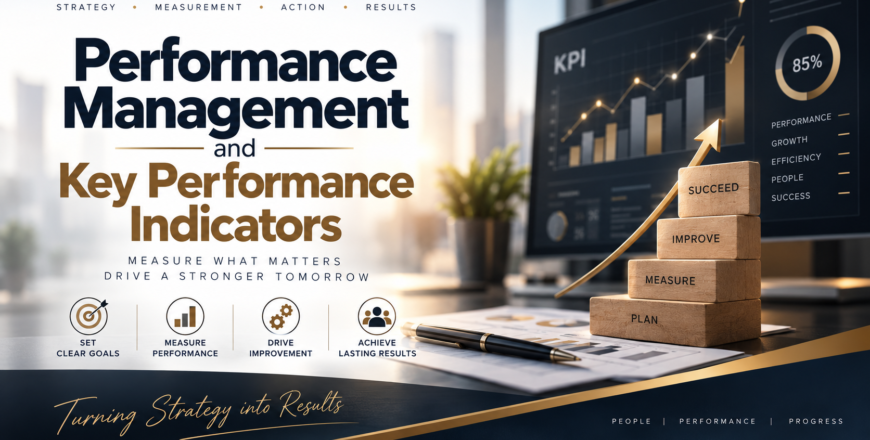
Performance Management and Key Performance Indicators





- Description
- Curriculum
- Notice
Arabic Title: إدارة الأداء ومؤشرات الأداء الرئيسية
Advanced 10-Day Professional Program
Duration: 10 Training Days
Daily Duration: Approximately 3–4 Hours
Total Training Hours: Approximately 50-60 Hours
Level: Advanced
Theory: 40%
Practical: 60%
Delivery: Classroom / Virtual / Blended
Language: English / Arabic
Course Overview
The Performance Management and Key Performance Indicators program helps managers, HR professionals, and performance specialists design and manage practical performance systems that connect organizational objectives with measurable results.
The course focuses on how to translate strategy into clear objectives, develop meaningful KPIs, define targets, monitor performance, conduct effective performance reviews, and use performance data to support better management decisions.
The program combines approximately 40% theoretical learning and 60% practical application.
Theoretical Component – 40%
Participants learn the essential concepts and frameworks related to:
- Performance Management
- Strategic Alignment
- Performance Objectives
- Key Performance Indicators
- Leading and Lagging Indicators
- KPI Selection Criteria
- Target Setting
- Performance Measurement
- Performance Review
- Performance Improvement
- KPI Governance
- Performance Reporting
Practical Component – 60%
Participants apply the concepts through:
- Strategic Objective Mapping
- KPI Design Workshops
- KPI Formula Development
- Target-Setting Exercises
- KPI Quality Assessment
- Performance Scorecard Development
- Performance Review Simulation
- Performance Improvement Planning
- Dashboard Design
- Final Performance Management Project
By the end of the course, participants will develop a practical Performance Management and KPI Framework that can be adapted to their organization.
Who Should Attend?
The program is suitable for:
- HR Directors
- HR Managers
- Performance Management Managers
- Performance Management Specialists
- HR Business Partners
- Strategic Planning Professionals
- Corporate Performance Specialists
- Organizational Development Professionals
- Department Heads
- Division Managers
- Team Leaders
- PMO Professionals
- Quality and Excellence Professionals
- Managers responsible for setting or reviewing KPIs
Who May Not Need This Program?
This advanced version may be less suitable for:
- Fresh graduates with no management or HR experience.
- Participants looking only for basic HR concepts.
- Employees who are not involved in performance measurement or management.
- Participants seeking a purely technical data analytics course.
A simplified foundation-level version can be developed if required.
Course Level
Advanced
Previous experience in HR, management, strategic planning, operations, quality, or organizational performance is recommended.
The course is particularly suitable for participants who are responsible for:
- Setting objectives.
- Developing KPIs.
- Reviewing employee or departmental performance.
- Monitoring organizational results.
- Managing performance improvement initiatives.
Course Objectives
By the end of the program, participants should be able to:
- Understand the role of performance management in organizational success.
- Translate strategic objectives into measurable performance objectives.
- Develop meaningful and relevant KPIs.
- Distinguish between objectives, measures, KPIs, targets, and initiatives.
- Design leading and lagging indicators.
- Establish realistic performance targets.
- Build departmental and individual performance scorecards.
- Conduct structured performance reviews.
- Analyze performance gaps.
- Develop performance improvement actions.
- Improve KPI reporting and monitoring.
- Establish a practical performance management cycle.
Learning Outcomes
Participants will be able to:
- Analyze organizational performance requirements.
- Translate strategy into measurable objectives.
- Design SMART performance objectives.
- Develop appropriate KPIs.
- Define KPI formulas and data sources.
- Set performance targets.
- Evaluate the quality of existing KPIs.
- Build performance scorecards.
- Conduct performance review discussions.
- Analyze performance gaps.
- Develop corrective and improvement actions.
- Design a basic KPI dashboard.
- Establish a structured performance review cycle.
Key Competencies Developed
- Performance Management
- KPI Development
- Strategic Alignment
- Target Setting
- Performance Measurement
- Performance Analysis
- Data Interpretation
- Performance Review
- Feedback
- Performance Improvement
- Management Reporting
- Decision-Making
Theoretical Course Content – 40%
Module 1: Performance Management Fundamentals
- What is Performance Management?
- Performance Management vs. Performance Appraisal
- Organizational, departmental, and individual performance
- Performance Management Cycle
- Roles of HR and line managers
- Common performance management challenges
Learning Focus:
Understanding performance management as a continuous management process rather than an annual appraisal exercise.
Module 2: Strategic Alignment and Performance Objectives
- Organizational Strategy
- Strategic Objectives
- Departmental Objectives
- Individual Objectives
- Cascading Objectives
- SMART Objectives
- Alignment between organizational and employee performance
Learning Focus:
Translating strategic priorities into clear and measurable performance expectations.
Module 3: Understanding KPIs
- What is a KPI?
- Measures vs. KPIs
- Objectives vs. KPIs
- KPIs vs. Targets
- Leading Indicators
- Lagging Indicators
- Quantitative and qualitative measures
- Strategic vs. operational KPIs
Module 4: Designing Effective KPIs
A good KPI should have:
- Clear purpose
- Defined formula
- Reliable data source
- Measurement frequency
- Clear ownership
- Appropriate target
- Relevant performance threshold
Participants learn how to avoid:
- Vanity metrics
- Excessive KPIs
- Unmeasurable indicators
- Indicators that cannot influence decisions
Module 5: Targets and Performance Standards
- Baselines
- Targets
- Thresholds
- Minimum acceptable performance
- Stretch targets
- Internal benchmarks
- Historical performance
- Target-setting considerations
Module 6: Performance Reviews and Improvement
- Performance Review Cycle
- Performance Monitoring
- Performance Conversations
- Feedback
- Performance Gaps
- Root Cause Analysis
- Corrective Actions
- Performance Improvement Plans
Practical Course Content – 60%
Practical Workshop 1: Strategic Objective Mapping
Scenario
A service organization has strategic priorities related to:
- Customer satisfaction
- Operational efficiency
- Employee capability
- Revenue growth
Task
Participants translate strategic priorities into measurable departmental objectives.
Output
Performance Objective Map
Practical Workshop 2: KPI Design
Participants receive several departmental objectives.
Task
Develop appropriate KPIs for each objective.
Participants define:
- KPI Name
- Definition
- Formula
- Data Source
- Frequency
- Owner
Output
KPI Definition Sheet
Practical Workshop 3: Good KPI vs. Bad KPI
Participants review a list of poorly designed indicators.
Examples may include:
- Improve customer service
- Train employees
- Reduce problems
- Increase quality
Task
Identify weaknesses and redesign them into measurable performance indicators.
Output
KPI Quality Assessment
Practical Workshop 4: KPI Formula and Target Setting
Participants work with performance data.
Task
Define:
- KPI Formula
- Baseline
- Target
- Threshold
- Measurement Frequency
Output
KPI Target Sheet
Practical Workshop 5: Performance Scorecard
Participants build a performance scorecard for a selected department.
Possible departments:
- HR
- Procurement
- Operations
- Customer Service
- Finance
- Projects
Output
Departmental Performance Scorecard
Practical Workshop 6: Performance Review Simulation
Scenario
A manager must review an employee whose results are below target in some areas but strong in others.
Participants Practice
- Reviewing evidence
- Asking performance questions
- Providing feedback
- Identifying performance gaps
- Agreeing on improvement actions
Output
Performance Review Record
Practical Workshop 7: Performance Gap Analysis
Participants receive performance results for several KPIs.
Task
Identify:
- Target gaps
- Possible causes
- Priority areas
- Corrective actions
Output
Performance Gap Analysis
Practical Workshop 8: Performance Improvement Plan
Participants prepare a structured plan for an underperforming area.
Output
Performance Improvement Plan
Including:
- Performance issue
- Root cause
- Required improvement
- Action
- Owner
- Timeline
- Success indicator
Practical Workshop 9: KPI Dashboard
Participants organize selected KPIs into a simple management dashboard.
Output
Performance Dashboard Prototype
The objective is not advanced data visualization, but learning how to present performance information clearly for decision-makers.
Final Applied Project
Design a Performance Management and KPI Framework
Participants develop a practical framework for a simulated department or organization.
The final project includes:
- Strategic Objectives
- Departmental Objectives
- KPI Definitions
- KPI Formulas
- Targets
- Data Sources
- KPI Owners
- Measurement Frequency
- Performance Scorecard
- Performance Review Process
- Performance Improvement Actions
- Implementation Plan
Final Output
Performance Management & KPI Framework
10-Day Course Outline
| Day | Main Theme | Theoretical Focus | Practical Application | Key Output |
|---|---|---|---|---|
| Day 1 | Performance Management | Performance Management principles and cycle | Performance System Diagnostic | Gap Analysis |
| Day 2 | Strategic Alignment | Strategy, objectives and cascading | Objective Mapping Workshop | Objective Map |
| Day 3 | KPI Fundamentals | Measures, KPIs, leading and lagging indicators | KPI Identification Exercise | KPI List |
| Day 4 | KPI Design | KPI criteria, definitions and ownership | KPI Design Workshop | KPI Definition Sheet |
| Day 5 | KPI Measurement | Formulas, data sources and frequency | KPI Formula Exercise | KPI Measurement Sheet |
| Day 6 | Target Setting | Baselines, targets and thresholds | Target-Setting Workshop | KPI Target Matrix |
| Day 7 | Performance Scorecards | Department and individual scorecards | Scorecard Workshop | Performance Scorecard |
| Day 8 | Performance Review | Monitoring, feedback and review discussions | Performance Review Simulation | Review Record |
| Day 9 | Performance Improvement | Gap analysis and corrective actions | Improvement Planning Workshop | Performance Improvement Plan |
| Day 10 | Integration | Performance governance and implementation | Final Applied Project | KPI & Performance Framework |
Main Case Study
Organizational Background
A fictional service organization employs approximately 1,500 employees across several departments.
Senior management has introduced a new three-year strategy, but the organization currently faces several challenges:
- Departments use different performance indicators.
- Some teams track more than 30 KPIs.
- Many indicators measure activities rather than results.
- Several KPIs have no defined formula.
- Managers disagree about targets.
- Performance reviews focus heavily on ratings rather than improvement.
Participant Task
Participants are required to:
- Review the organizational objectives.
- Develop departmental objectives.
- Identify appropriate KPIs.
- Remove unnecessary indicators.
- Define KPI formulas.
- Identify data sources.
- Set proposed targets.
- Build a departmental scorecard.
- Design a performance review approach.
- Develop an improvement plan.
Case Study Evaluation Criteria
| Criterion | Weight |
|---|---|
| Strategic Alignment | 20% |
| Quality of KPIs | 25% |
| Measurement Logic | 20% |
| Target Setting | 15% |
| Practical Applicability | 15% |
| Presentation | 5% |
Course Tools and Templates
Participants may receive:
- Performance Management Diagnostic
- Strategic Objective Mapping Template
- SMART Objective Template
- KPI Identification Worksheet
- KPI Definition Card
- KPI Formula Template
- KPI Quality Checklist
- KPI Target Matrix
- Performance Scorecard Template
- Performance Review Form
- Performance Gap Analysis
- Root Cause Analysis Template
- Performance Improvement Plan
- KPI Dashboard Template
- Performance Action Plan
- 90-Day Implementation Plan
Training Methodology
The course uses:
- Interactive Presentations
- Practical Workshops
- Case Studies
- Group Exercises
- Performance Review Simulations
- Problem-Based Learning
- Individual Exercises
- Peer Review
- Applied Projects
- Final Capstone Project
Approximately 60% of the course is dedicated to practical application.
Participant Assessment
Suggested assessment structure:
| Assessment | Weight |
|---|---|
| Pre- and Post-Assessment | 10% |
| Practical Exercises | 25% |
| Performance Review Simulation | 15% |
| Case Study | 20% |
| Final Applied Project | 30% |
Suggested Completion Requirement
Approximately 70% overall, together with applicable attendance requirements.
Training Impact Measurement
After 30 Days
Possible indicators include:
- Number of KPIs reviewed.
- Percentage of KPIs with clear definitions.
- Use of standardized KPI templates.
- Alignment between objectives and KPIs.
After 60 Days
Possible indicators include:
- Improved consistency of performance reviews.
- Percentage of KPIs with clear owners.
- Percentage of KPIs with defined data sources.
- Performance improvement actions initiated.
After 90 Days
Possible indicators include:
- Reduction in unnecessary KPIs.
- Improved KPI reporting quality.
- Increased use of performance data in management meetings.
- Percentage of performance gaps with documented action plans.
- Manager feedback on the effectiveness of the revised performance system.
Final indicators should be selected based on organizational priorities and available data.
Recommended Trainer Profile
The trainer should ideally have:
- A university qualification in Human Resources, Business Administration, Management, Strategic Planning, Organizational Development, or a related field.
- Practical experience in Performance Management and KPI development.
- Experience working with managers, HR teams, or organizational performance units.
- Strong knowledge of performance measurement and target setting.
- Practical facilitation experience.
- Ability to guide participants in developing KPIs and scorecards.
Professional HR, strategy, performance, or quality certifications may be beneficial but are not mandatory where appropriate practical experience exists.
Delivery Requirements
Recommended requirements include:
- Professional training room
- Projector or large screen
- Flipcharts
- Whiteboards
- Breakout tables
- Participant laptops where required
- Spreadsheet software such as Excel
- Digital or printed workshop templates
For virtual delivery:
- Online meeting platform
- Breakout rooms
- Screen sharing
- Digital worksheets
- Collaboration tools
Course Customization
Flexible & Customizable Training
The standard recommended format is:
10 half-day sessions of approximately 3–4 hours per day.
The program can be customized according to the organization’s:
- Industry
- Organizational structure
- Strategic objectives
- Existing performance management system
- KPI framework
- Competency framework
- Employee levels
- Internal policies
- Performance review cycle
- Reporting requirements
The organization may also provide anonymized examples of existing KPIs, scorecards, or performance forms for use within customized workshops.
Organizational Value
The program can help organizations:
- Improve alignment between strategy and performance.
- Develop clearer performance objectives.
- Improve the quality of organizational KPIs.
- Reduce unnecessary or low-value indicators.
- Establish clearer KPI ownership.
- Improve target-setting practices.
- Strengthen performance review conversations.
- Improve performance gap analysis.
- Develop more structured performance improvement actions.
- Create a more consistent performance management approach across departments.
Call to Action
Looking to strengthen performance management and KPI practices across your organization?
The program can be customized according to your organization's strategy, existing KPIs, performance management framework, employee levels, reporting requirements, and development priorities.
🌐 www.masteryofresults.com
📧 training@masteryofresults.com
📱 WhatsApp: +60 11-1113 5547
Mastery of Results – Training & Consulting Solutions
Kuala Lumpur, Malaysia