
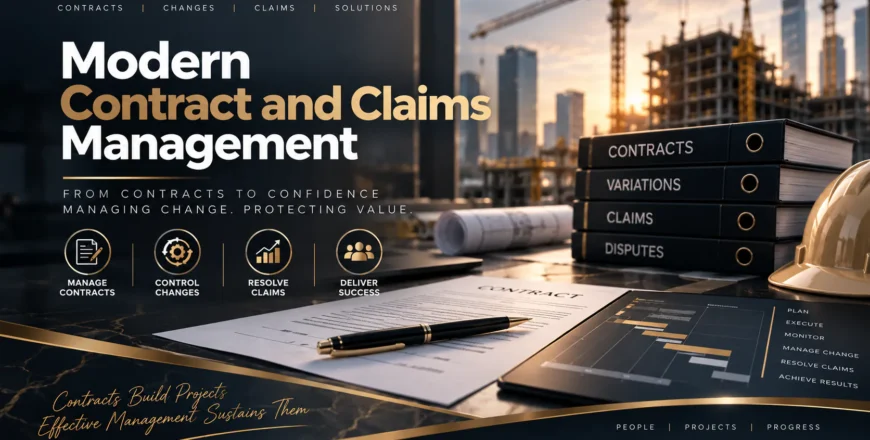
Modern Contract and Claims Management





- Description
- Curriculum
- Notice
One-Month Applied Professional Program
Duration: 1 Month
Recommended Training Hours: Approximately 90–120Hours
Level: Intermediate to Advanced
Theory: 40%
Practical: 60%
Delivery: Classroom / Virtual / Blended
Language: English / Arabic
Course Overview
The Modern Contract and Claims Management program is designed to help professionals manage contracts more effectively throughout their lifecycle and deal systematically with changes, delays, variations, claims, disputes, and contractual documentation.
Effective contract management requires more than understanding contract clauses. Professionals must be able to identify contractual obligations, monitor performance, manage changes, maintain proper records, recognize potential claim events, assess entitlement, evaluate time and cost impacts, and prepare well-structured contractual correspondence and claims.
The program combines approximately 40% theoretical learning and 60% practical application, with a strong focus on realistic contract scenarios, claim analysis, variation management, documentation, and decision-making.
Participants will work with practical examples and simulated contract documents and will develop a structured Contract and Claims Management Framework that can be adapted to their organizational environment.
Theoretical Component – 40%
Participants learn the essential concepts and methods related to:
- Contract Management Fundamentals
- Contract Lifecycle
- Contract Roles and Responsibilities
- Contractual Obligations
- Scope and Deliverables
- Contract Administration
- Contract Documentation
- Notices and Correspondence
- Change Management
- Variations
- Claims Fundamentals
- Contractual Entitlement
- Cause and Effect
- Delay Events
- Time-Related Claims
- Cost-Related Claims
- Extension of Time
- Disruption
- Records and Evidence
- Claim Evaluation
- Negotiation of Claims
- Dispute Prevention
- Contract Closeout
Practical Component – 60%
Participants apply the concepts through:
- Contract Review Exercise
- Contract Obligation Mapping
- Scope and Responsibility Analysis
- Contract Risk Identification
- Variation Assessment
- Contractual Notice Exercise
- Claim Event Identification
- Delay Scenario Analysis
- Extension of Time Exercise
- Cost Claim Analysis
- Claim Documentation Review
- Contract Correspondence Drafting
- Claim Evaluation Workshop
- Claim Negotiation Simulation
- Final Contract & Claims Management Project
By the end of the program, participants will develop practical tools including a:
Contract Administration Plan, Variation Register, Claims Register, and Claim Assessment Report.
Who Should Attend?
The program is suitable for:
- Contract Managers
- Contract Administrators
- Commercial Managers
- Claims Managers
- Project Managers
- Project Engineers
- Quantity Surveyors
- Cost Engineers
- Project Control Professionals
- Planning Engineers
- Procurement Professionals
- Contract Specialists
- Legal and Contract Support Professionals
- Construction Professionals
- Engineering Professionals
- Consultants
- Client Representatives
- Contractor Representatives
- Professionals responsible for contract administration and claims
Who May Not Need This Program?
The course may be less suitable for:
- Participants with no exposure to contracts or project environments.
- Professionals looking specifically for advanced legal litigation training.
- Participants seeking a course focused exclusively on contract drafting.
- Lawyers seeking detailed jurisdiction-specific legal analysis.
- Participants requiring specialist arbitration certification.
A foundation-level contract management program can be developed for beginners.
Course Level
Intermediate to Advanced
Previous exposure to contracts, procurement, projects, engineering, construction, commercial management, or contract administration is recommended.
Participants should ideally understand basic concepts such as:
- Contract Scope
- Deliverables
- Project Schedule
- Payments
- Variations
- Contract Responsibilities
- Project Documentation
Course Objectives
By the end of the program, participants should be able to:
- Understand the complete contract management lifecycle.
- Identify key contractual obligations and responsibilities.
- Improve contract administration and documentation practices.
- Identify and manage contract changes and variations.
- Recognize events that may give rise to contractual claims.
- Assess the basis of contractual entitlement.
- Analyze cause, effect, and responsibility.
- Evaluate time-related and cost-related claims.
- Understand Extension of Time principles.
- Improve contractual notice and correspondence practices.
- Develop structured claim documentation.
- Review and evaluate submitted claims.
- Improve claim negotiation and dispute prevention.
- Support effective contract closeout.
Learning Outcomes
Participants will be able to:
- Analyze key contract requirements.
- Identify contractual obligations.
- Build an obligation matrix.
- Monitor contract performance.
- Identify variation events.
- Prepare structured contractual notices.
- Distinguish between changes, variations, and claims.
- Analyze potential claim events.
- Assess contractual entitlement.
- Analyze cause-and-effect relationships.
- Evaluate delay scenarios.
- Review time-related claims.
- Assess cost impacts.
- Maintain claims and variation registers.
- Evaluate claim submissions.
- Prepare claim recommendations.
- Support claim negotiations.
- Improve contract documentation and records.
Key Competencies Developed
- Contract Administration
- Contractual Analysis
- Claims Management
- Variation Management
- Contract Documentation
- Contractual Correspondence
- Delay Analysis Awareness
- Extension of Time Assessment
- Cost Claim Evaluation
- Commercial Awareness
- Contract Risk Management
- Negotiation
- Dispute Prevention
- Analytical Thinking
- Decision-Making
Participant Task
Participants work with a simulated project contract and are required to:
- Review key contractual requirements.
- Identify major obligations of the parties.
- Develop a Contract Obligation Matrix.
- Identify potential contract risks.
- Review change and variation events.
- Determine whether contractual notices are required.
- Analyze potential claim events.
- Assess contractual entitlement.
- Evaluate cause and effect.
- Review schedule and cost impacts.
- Prepare a Claims Register.
- Evaluate a submitted claim.
- Prepare a management recommendation.
- Participate in a simulated claim negotiation.
Final Output
Contract & Claims Management File
including:
- Contract Obligation Matrix
- Variation Register
- Claims Register
- Notice Tracker
- Claim Assessment
- Management Recommendation
Case Study Evaluation Criteria
| Criterion | Weight |
|---|---|
| Contractual Analysis | 20% |
| Identification of Entitlement | 20% |
| Cause-and-Effect Analysis | 15% |
| Documentation & Evidence | 15% |
| Claim Evaluation | 20% |
| Practical Recommendation | 10% |
Course Tools and Templates
Participants may receive:
- Contract Review Checklist
- Contract Obligation Matrix
- Responsibility Matrix
- Contract Risk Register
- Contract Deliverables Tracker
- Contract Correspondence Log
- Notice Template
- Notice Tracking Register
- Variation Request Form
- Variation Register
- Change Assessment Template
- Claims Register
- Claim Event Checklist
- Claim Analysis Template
- Entitlement Assessment Sheet
- Cause-and-Effect Analysis Template
- Extension of Time Review Template
- Cost Claim Review Sheet
- Claim Documentation Checklist
- Claim Evaluation Report
- Negotiation Preparation Sheet
- Contract Closeout Checklist
Training Methodology
The program uses:
- Interactive Presentations
- Practical Contract Workshops
- Case Studies
- Document Review Exercises
- Contract Analysis
- Claim Analysis Exercises
- Delay Scenarios
- Group Workshops
- Contract Correspondence Exercises
- Negotiation Simulations
- Problem-Based Learning
- Peer Review
- Final Applied Project
Approximately 60% of the program is dedicated to practical activities, contract scenarios, document analysis, and claim-related exercises.
Participant Assessment
Suggested assessment structure:
| Assessment | Weight |
|---|---|
| Pre- and Post-Assessment | 10% |
| Practical Contract Workshops | 25% |
| Variation & Notice Exercise | 15% |
| Claim Analysis Case Study | 20% |
| Final Applied Project | 30% |
Suggested Completion Requirement
Approximately 70% overall, together with applicable attendance requirements.
The final assessment approach can be customized according to the organization’s training policies and participant level.
Training Impact Measurement
After 30 Days
Possible indicators include:
- Increased use of standardized contract registers.
- Improved identification of contractual obligations.
- Better documentation of contract changes.
- Improved use of contractual notices.
- Increased consistency in contract correspondence.
After 60 Days
Possible indicators include:
- Percentage of variations properly documented.
- Percentage of potential claims recorded early.
- Improved completeness of claim supporting records.
- Better coordination between project, commercial, and contract teams.
- Reduction in undocumented contractual changes.
After 90 Days
Possible indicators include:
- Improved quality of claim assessments.
- Improved contract administration consistency.
- Reduction in avoidable claim documentation gaps.
- Better management visibility of contract and claim status.
- Improved timeliness of contractual notices.
- More structured negotiation and dispute-prevention practices.
Final indicators should be selected according to the organization’s contract environment and available performance data.
Delivery Requirements
Classroom Delivery
Recommended facilities include:
- Professional Training Room
- Projector or Large Screen
- Flipcharts
- Whiteboards
- Breakout Tables
- Participant Laptops
- Spreadsheet Software
- Sample Contract Documents
- Printed or Digital Contract Templates
- Sample Variation and Claim Files
Virtual Delivery
Recommended requirements include:
- Virtual Meeting Platform
- Breakout Rooms
- Screen Sharing
- Digital Collaboration Tools
- Electronic Contract Documents
- Digital Contract and Claims Templates
No specialist claims software is required for the standard version of the program.
Course Customization
Flexible & Customizable Training
The recommended format is a one-month applied professional program.
The duration, schedule, content, and practical activities can be customized according to:
- Contract Type
- Project Type
- Industry
- Participant Level
- Client / Contractor Perspective
- Contract Administration Procedures
- Procurement Model
- Project Complexity
- Existing Claims Procedures
- Internal Approval Processes
- Reporting Requirements
- Organizational Contract Templates
- Applicable Legal Environment
For customized corporate delivery, participants may work with anonymized contract clauses, variations, notices, correspondence, and claim examples provided by the organization.
Because contract and claims requirements can vary significantly by contract form, project environment, and jurisdiction, the final program should be adapted to the client’s contractual and regulatory context.
Sector Customization
The program can be adapted for:
- Construction
- Engineering
- Oil & Gas
- Energy
- Infrastructure
- Government Projects
- Utilities
- Telecommunications
- Transportation
- Manufacturing
- EPC Projects
- Maintenance Contracts
- Technology Projects
- Facilities Management
- Corporate Procurement
- Service Contracts
Organizational Value
The program can help organizations:
- Improve contract administration practices.
- Clarify contractual responsibilities.
- Improve documentation of contract changes.
- Strengthen variation management.
- Identify potential claims earlier.
- Improve contractual notice management.
- Strengthen claim documentation.
- Improve consistency of claim assessments.
- Support better commercial decision-making.
- Reduce avoidable contractual misunderstandings.
- Improve coordination between project, contract, commercial, and legal teams.
- Strengthen dispute-prevention practices.
Course Note
This program is designed as a one-month applied professional course, combining approximately 40% theoretical learning and 60% practical application.
The course includes contract review exercises, variation management, contractual notices, claim identification, entitlement assessment, time and cost claim analysis, documentation review, claim evaluation, and negotiation simulations.
The program is fully customizable. Duration, schedule, contract cases, practical activities, participant level, contract type, and delivery format can be adjusted according to the organization's projects, industry, internal contract procedures, and specific requirements.
Contractual and claims-related content should also be adapted, where necessary, to the applicable contract form, governing law, and jurisdiction.
Related Courses
- Professional Project Management
- Project Planning, Scheduling and Control
- Project Risk Management
- Strategic Procurement and Supplier Negotiation
- Crisis Management and Business Continuity
Call to Action
Looking to Strengthen Contract and Claims Management Across Your Organization?
The program can be customized around your organization's contracts, project environment, existing contract administration procedures, variation processes, claims practices, participant responsibilities, and contractual requirements.
🌐 www.masteryofresults.com
📧 training@masteryofresults.com
📱 WhatsApp: +60 11-1113 5547
Mastery of Results – Training & Consulting Solutions
Kuala Lumpur, Malaysia